|
For best results, use JENZAC™
as a reward for your students prior to the lessons.
The should be just for fun to allow them to get familiar
with the pieces. This can be accomplished in a competition or strategy game with other
students or just simple enjoying puzzle solving fun.
(Use the information below to adjust the level of
difficulty.)
JENZAC™
has something for a wide range of ages and skill levels.
Each student should start where they feel comfortable and able to solve
the puzzle. Then, they should be
challenged to do the next level of difficulty.
The level of difficulty varies with the shape and the time given to solve
it. Obviously, the less time given
to solve a puzzle, the more difficult it becomes.
Just don’t cut the time too short.
In addition, the following general progression is recommended in order of
ascending difficulty:
- The
following 2-dimentional shapes are the simplest and can be solved with the
single cube placed anywhere within the shape.
The shapes are arranged in order of difficulty from left
to right. Once a student has gotten comfortable solving these shapes with the
freedom of placing the single cube where and when they like; the puzzle can
be made more difficult by stipulating the single cube location and making it
stationary before any other pieces are used to solve the shape.

- The
remaining 2-dimentional shapes are arranged in order of difficulty from left
to right. Some can be
solved with the single cube located in several places and a few have only
one solution know at this time. (Excluding rotations and flips of the same
solution of course.)
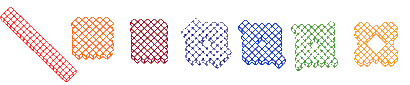
Click on any shape to
see an 8.5x11 help sheet you can print out.
Click on any shape to
see an 8.5x11 help sheet you can print out.
Click on any shape to
see an 8.5x11 help sheet you can print out.
- The
following 3-dimentional shapes can be solved with the single cube placed
anywhere within the shape. Again,
once a student has gotten comfortable solving these shapes with the freedom
of placing the single cube where and when they like; the puzzle can be made
more difficult by stipulating the single cube location and making it
stationary before any other pieces are used to solve the shape.
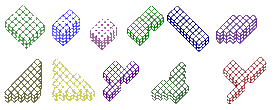
Click on any shape to
see an 8.5x11 help sheet you can print out.
- The
remaining 3-dimentional shapes are arranged in order of difficulty from left
to right and down. Some can be
solved with the single cube located in several places and a few have only
one solution know at this time. (Excluding rotations and flips of the same
solution of course.)
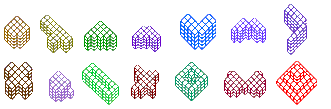
|
 TM
TM