My name is Gene Phillips. I am a civil engineer by trade and, as do
most engineers, I enjoy solving problems and/or puzzles of all shapes and
sizes. I invented JENZAC™
in 1987 as a puzzle for my daughter. My
original intent was to keep it very simple, and again being the engineer, I
couldn't resist making it more challenging. The puzzle started with the
concept of combining sixty cubes from a 6x10 grid to make different puzzle
pieces. I wanted to have pieces containing from one cube to six cubes and
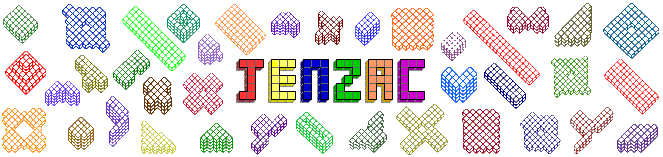
after several iterations, came up the the fourteen JENZAC™
pieces we use today.
Then the fun really began. I had to satisfy my curiosity
to see if these same fourteen pieces could be rearranged and still solve the
6x10 puzzle. Sure enough they could. Then I had to ask myself,
could the puzzle be solved with the single cube placed in any one of the 60
possible locations within the 6x10 grid. Yes that's right, it sure
can. Now I had to try some different shapes, like a 5x12 or a 4x15, and
ask the same questions; and, yes it still worked. Now the big question.
Will it work in three-dimensions? Yes, it worked for a 2x5x6 and a
3x4x5. I also discovered other shapes to solve with the same fourteen
pieces. After many, many hours of puzzle solving I knew I had to try to
market my new puzzle.
I decided to market JENZAC™
as a puzzle and a game. The puzzle part was obvious, simply try to solve
all the various shapes, including the 60 plus configurations of the simpler
shapes. The game was simple also. Since the single cube can be
located anywhere within the simpler shapes and the puzzle solved, you can play
against any number of opponents working within a set time limit to solve the
puzzle. The catch
is your opponent gets to set the locations of the cube before you start.
For more detail, see the JENZAC™
Games page.
Recently, with the help of The University of Oklahoma,
we have written and added an education curriculum section to our web site to
help teachers use JENZAC™
in the class room. Our hope is to add to
and expand this section to a real set of resources our teachers can use to
engage new minds in the area of mathematics and science.
I originally had the pieces laser cut out from
different hard woods
and sold them in craft shows etc. and in a few game stores through out
Oklahoma and Missouri. As you might expect, every-so often someone would
say, "Oh, that's like...", and I would have a puzzled looked on my
face thinking, "How can this be, I invented it?" It turns
out, as you might have guessed, there are similar puzzles out there. Some
have been around for a very long time.
First let me explain the similarities of some of these and then I'll explain the big difference.
As I have discovered researching these questions, the different geometric shapes created from
combining cubes or squares was
defined by a Mathematician name Solomon Golomb in a talk in 1953 at the Harvard
Mathematics Club as polyominoes. More specifically, polyominoes
are figures formed of congruent squares placed so that the squares share a side.
Most of you have experienced dominoes, which is formed with 2 squares.
Some of you, I'm sure, have seen Tetris™ which is formed form tetrominoes or combinations of four squares. And there has been many
studies, games and art forms created using pentominoes (The 12 figures derived
from the combinations of 5 squares). Since JENZAC™
uses different polyomino figures, it's easily associated with these other
puzzle forms.
So what makes JENZAC™
different? There are many things. First is the use of
the single cube. JENZAC™
is the only puzzle of this type, to our knowledge, that uses
the single cube to track different puzzle solutions and play games.
Second, JENZAC™ uses combinations of squares ranging from 1 to 6 squares. The
others use only one group; ie. pentominoes is combinations of 5 squares and
Tetris™ the combinations of 4 squares. There are also variances in
puzzle shapes and rules to the games etc.
The bottom line is, JENZAC™
is unique in many aspects and will challenge your mind in far more
ways. My hope is you will have as much fun solving it's many mysteries as
I have had in creating it. Or should I say, as I am having creating
it. My work is still not done. (We're working on new materials, new
shapes, additional educational tools and more. So, check us out regularly for new
stuff. And as always, give us you comments and ideas on how to make JENZAC™
better.)
Sincerely,
M. Gene Phillips, P.E.
 TM
TM